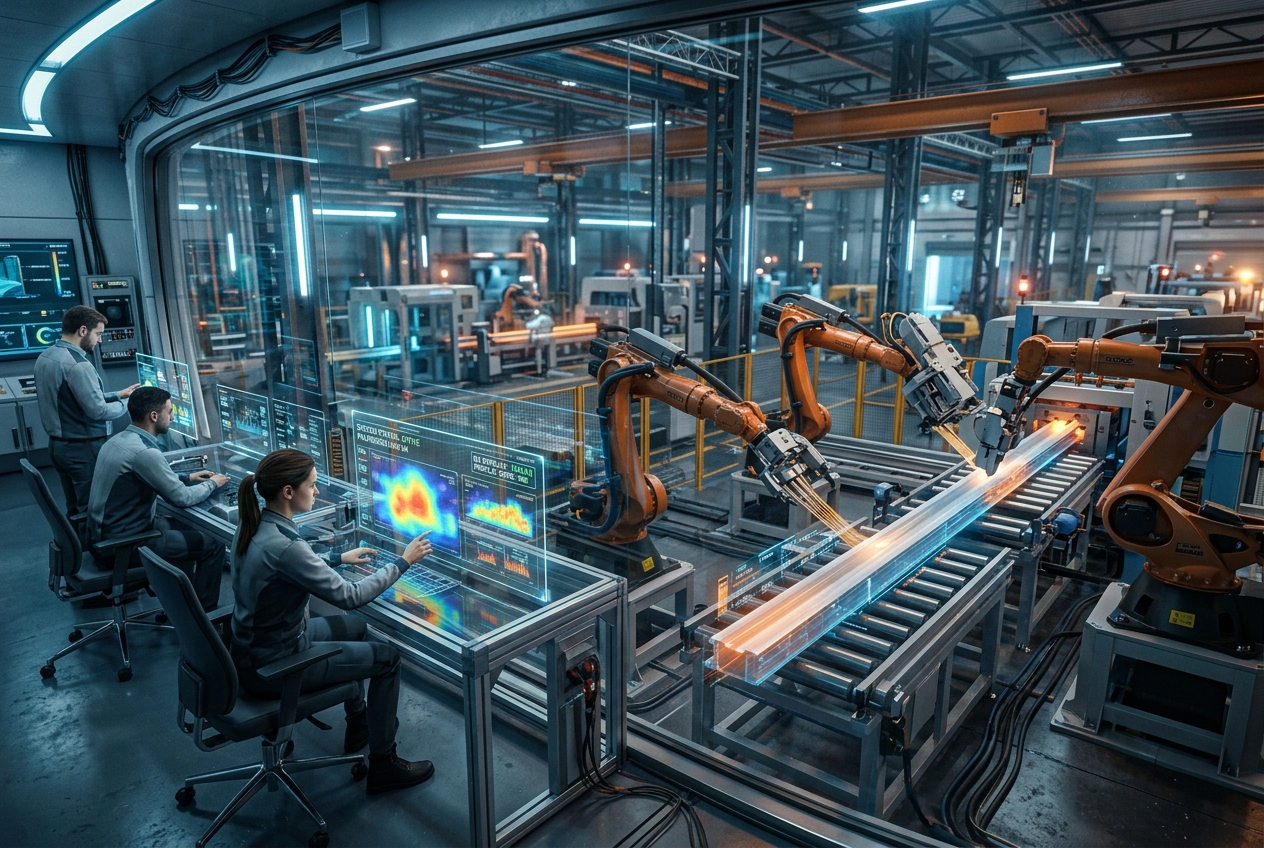
⚡ Industry 4.0 Smart Factory Insight
Continuous pultrusion lines pulling glass-reinforced structural profiles (I-beams, channels, gratings) at speeds up to 1.5 meters per minute cannot rely on manual post-process inspection. A defect missed at the die exit can result in hundreds of meters of rejected product. By integrating real-time computer vision and infrared thermography, AI models detect internal delamination and surface cracks instantly, ensuring zero-defect production.
FRP pultrusion is a continuous manufacturing process where reinforcing fibers are saturated with liquid polymer resin and pulled through a heated steel forming die. Curing takes place inside the die, meaning pull speed, zone temperatures, and fiber tension must be balanced perfectly. Slight variations can lead to structural defects like internal voids, surface cracks, or incomplete resin wet-out.
Integrating artificial intelligence (AI) and machine learning (ML) models onto pultrusion lines transforms traditional manufacturing into a smart factory. By processing data from thermal cameras, acoustic emission sensors, and pulling-force load cells, AI algorithms identify structural abnormalities at the die exit in real time, preventing waste and ensuring consistency.
Neural Network Defect Detection and Image Classification
The core of AI-powered quality control is an advanced convolutional neural network (CNN) trained to classify surface defects based on high-speed camera feeds. Defect classification utilizes predictive probability modeling to isolate surface issues:
Mathematical Probability Formulation for Defect Severity
Defect Index (D_idx) = ∑ (w_i × P_defect_i) + (F_pull / F_limit)
Decision Thresholds:
1) Normal Process State: D_idx ≤ 0.35 [Continuous Operation]
2) Warning / Adjust Parameters: 0.35 < D_idx ≤ 0.65
3) Critical Defect / Auto Line Stop: D_idx > 0.65
P_defect = Defect probability from CNN | F_pull = Pull force load cell feedback | F_limit = Safe pulling force threshold
The CNN model analyzes the surface texture of pultruded profiles as they emerge from the die. If the system detects cracks, fiber misalignment, or dry spots, it calculates a defect index. If the index exceeds warning levels, the process control system automatically adjusts the pull speed or die zone heating to correct the curing dynamics before failure occurs.
Sensor Fusion Architecture for Real-Time Monitoring
To detect internal defects like resin starvation or micro-voids, the AI system utilizes a multi-sensor fusion architecture, combining data from various inspection nodes:
Infrared Thermography
FLIR thermal cameras measure profile surface temperatures at the die exit, mapping the exothermic curing profile to detect internal delamination points.
Laser Profile Scanners
3D laser scanners measure geometric dimensions (wall thickness, flange angle) with 10-micron accuracy, flagging structural deviations.
Acoustic Emission Sensors
Piezoelectric sensors detect micro-cracking sounds inside the forming die, warning of internal stress buildup before it reaches the surface.
By combining thermal, geometric, and acoustic data, the AI model constructs a comprehensive quality profile for every meter of pultruded product. This data is logged alongside the profile's batch number, providing full structural traceability for critical infrastructure projects like pipe bridges, chemical catwalks, and electrical cable tray systems.
Pultrusion Defect Classification Matrix
The AI system classifies defects into three severity categories, each triggering automated actions on the production line:
| Defect Type | Physical Manifestation | AI Detection Sensor Node | Automated PLC System Action |
|---|---|---|---|
| Surface Cracks | Micro-fissures in outer resin layer | Optical Vision Cameras | Adjust die zone 3 cooling, reduce pull speed 5% |
| Internal Voids | Air pockets, incomplete fiber wet-out | Infrared Thermography | Log defect location, flag for post-run shear test |
| Blistering | Localized swelling due to trapped vapor | Laser 3D Profile Scanners | De-energize heater band 2, trigger audible operator alarm |
| Fiber Blooming | Exposed glass fibers on outer surface | Optical Vision / Texture Analysis | Increase resin bath pressure, check glass creel tension |
This automated loop minimizes raw material waste. Rather than discarding entire production runs, the smart system adjusts operating parameters in real time, correcting curing issues within centimeters of detection and maintaining stable, high-yield manufacturing.
Smart Factory Implementation Case Study
Prior to installing the AI monitoring system, verifying product quality required manual cutting and physical testing of samples at the end of each production run. If a curing issue occurred, it went unnoticed until tests were complete, leading to significant material waste. The new real-time AI system resolved these issues, reducing scrap rates, lowering energy consumption by 15%, and ensuring that every profile conforms to international load-bearing standards.
Sensor Calibration & Environmental Maintenance
Operating sensitive camera sensors and laser scanners in an industrial composites factory requires strict environmental protection. Pull-preformance areas must be fitted with protective glass enclosures and clean air purging systems to prevent polymer dust or monomer vapors from clouding optical lenses. Weekly calibration procedures against standard calibration blocks ensure laser scanner accuracy is maintained within tolerances. In addition, deep learning training models must be updated semi-annually with new manufacturing dataset variations to ensure high defect classification accuracy under varying ambient temperature and humidity conditions.
Engineering Conclusion & Future Outlook
Implementing AI-driven quality control is the future of advanced composite manufacturing. By combining computer vision, thermal analysis, and automated feedback loops, Ghaziabad Polymers Pvt. Ltd. ensures that its pultruded FRP profiles meet the highest quality and safety standards. Contact our technical department to learn more about our smart pultrusion manufacturing capabilities.


